


There is one thing I see repeatedly with local businesses when discussing local SEO and online marketing.
The moment you mention content, their eyes glaze over.
Many still believe local SEO works by some magic. Create a homepage, add a service page, verify a Google Business Profile and somehow Google sends customers flooding through the door.
That is not really how it works anymore.
Google has become exceptionally good at understanding intent, context and expertise. Your Google Business Profile, website and content ecosystem all work together to help search engines understand exactly what your business does and when it should appear in search results.
And importantly, not every customer is ready to buy the second they search.
Content Is Not Just Blogging
One of the biggest misconceptions in local marketing is that content means writing blog posts.
It does not.
Depending on your business, content could include:
- Research based articles
- Technical guides
- Tutorials
- Videos
- FAQs
- Supporting educational pages
- Product explainers
- Case studies
- Comparison content
- Troubleshooting advice
All of these help users during different stages of their buying journey.
I dislike using the phrase because it has become painfully overused in marketing circles, but this is genuinely how businesses become authorities in their online space.
Not through shouting louder.
Not through stuffing keywords everywhere.
By becoming genuinely useful.
But I Am Just A Small Business
This is usually the next response.
The reality is, being a smaller business is often an advantage online.
Most searches are not immediate purchase decisions. There are only a handful of industries where somebody needs a service instantly. Emergency plumbers, locksmiths and recovery vehicles, for example.
Most users go through a research process first.
Let us take a simple example.
A person wakes up with a bad back. They do not immediately search for:
“Chiropractor near me”
Their journey usually starts with uncertainty.
Why does my back hurt? Have I slept badly? Should I stretch it? Is it muscular? Do I need a chiropractor, physiotherapist or massage therapist? Should I rest or exercise?
Every one of those searches is part of the customer journey.
Now, imagine a local chiropractor has created genuinely useful content answering those questions. Not sales pages. Helpful content that guides users through the problem.
The user keeps seeing the same business repeatedly during their research phase. Without even realising it, they begin building familiarity and trust with that brand.
That business becomes the guide.
Eventually, the user reaches the final stage:
“Chiropractor for bad back near me”
And there again is the same business that has already helped them through the process.
At that point, the click becomes the obvious choice.
The Zero Moment Of Truth
There is a marketing concept called the Zero Moment of Truth, often shortened to ZMOT.
It sounds terribly corporate, but the principle behind it is very real.
This is the moment between a user recognising a problem and making a buying decision.
Years ago, people may have relied on recommendations from friends or picked from a newspaper advert. Today, users research extensively before committing to anything.
- They compare.
- They read reviews.
- They watch videos.
- They look for reassurance.
Research suggests users often consult multiple sources before making a purchasing decision, including Google Search, Maps, YouTube, forums, reviews and social media.
This is the exact point where your content becomes incredibly valuable.
Users at this stage do not want aggressive sales pitches.
They want answers.
That means your website should help users understand:
- Their problem
- Their options
- Potential solutions
- Risks
- Costs
- Expectations
- Outcomes
If your content does this well, you intercept the user before they even start comparing businesses seriously.

Content Mapping Matters
One of the biggest mistakes businesses make is creating random content without structure.
Good local content mirrors the customer journey.
Awareness Stage
This is where the user is trying to understand the problem.
Content here could include:
- Educational articles
- Beginner guides
- Common symptom explanations
- Simple tutorials
- Industry explainers
Research Stage
Now the user understands the issue and starts evaluating solutions.
This is where content becomes more detailed.
Useful content could include:
- Technical guides
- Comparison pages
- Videos
- Cost breakdowns
- Frequently asked questions
- Product or service comparisons
Decision Stage
At this point, users are narrowing down providers.
This is where trust becomes critical.
Content here could include:
- Case studies
- Testimonials
- Reviews
- Before and after examples
- Demonstration videos
- Success stories
This layered content strategy helps users move naturally through the buying process.
Your Website Teaches Google Too
This is the part many businesses overlook entirely.
Content is not just for users.
It also teaches Google.
Your service page may mention chiropractic treatment, but your supporting content may reveal that you also help with:
- Sciatica
- Sports injuries
- Office posture issues
- Lower back pain
- Mobility problems
- Pregnancy related discomfort
- Sleep posture problems
That supporting information helps Google build a far more nuanced understanding of your business.
Machine learning systems pull information from across your website to better understand relevance and expertise.
This understanding often translates directly into local visibility within Google Business Profiles and Google Maps.
Sometimes this can even trigger highly targeted local results, where Google identifies a business as especially relevant to a specific niche search query.
In certain lower competition searches, this can result in what many local SEOs refer to as a “One Pack”.
Instead of showing multiple local businesses, Google may surface a single highly relevant business profile prominently within the results.
In the screenshot, Google has identified a highly relevant local business result directly connected to the user’s query.
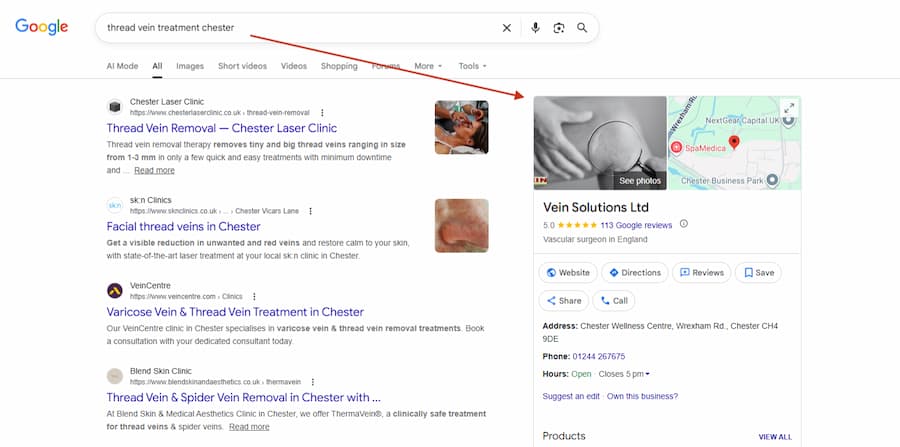
This type of visibility rarely happens accidentally.
It is usually supported by strong topical relevance and supporting content.
Content Builds Brand Affinity
One of the most overlooked aspects of content marketing is familiarity.
People trust businesses they repeatedly encounter.
Even when users are not consciously making decisions, repeated exposure creates recognition and comfort.
Psychologically, users begin to associate your business with expertise and reliability simply because your content consistently helps them in their research.
This is especially powerful for local businesses because trust is one of the largest deciding factors in local purchasing behaviour.
People are not simply buying a service.
They are buying reassurance.
Modern Search Behaviour Has Changed
Years ago, users searched very directly.
Today, search journeys are fragmented.
A user may:
- Search on Google
- Watch YouTube videos
- Read Reddit discussions
- Check reviews
- Visit Maps
- Return to Google again
- Search using conversational AI
- Compare businesses across multiple devices
Businesses relying solely on service pages are struggling because they only try to intercept the user at the very end of the process.
By then, the user may already trust another brand entirely.
Content allows you to be present throughout the journey, not just at the finish line.
AI Search Is Reinforcing This Even More
AI driven search experiences are pushing this even further.
Search engines increasingly look for businesses that demonstrate topical depth and genuine expertise.
Thin websites with five service pages and no supporting information are becoming less competitive.
Search engines want confidence that a business genuinely understands its field.
Supporting content helps provide those signals.
The businesses investing in useful educational content now are positioning themselves far better for the future of search.
Content Also Fuels Your Google Business Profile
Many businesses mentally separate their website and their Google Business Profile.
Google does not.
Your website content supports the understanding of your business profile.
Strong topical relevance can influence:
- Search visibility
- Service relevance
- Local discovery
- Query matching
- User engagement
- Website clicks
- Direction requests
- Calls
This is why businesses with genuinely strong supporting content often appear for highly specific searches that competitors completely miss.
The Businesses Winning Locally
The businesses performing well online today are usually doing one thing consistently better than their competitors.
They are helping users before asking for the sale.
That is the difference.
Not tricks.
Not hacks.
Not secret SEO loopholes.
Useful content.
Businesses that understand their customers deeply and create content around real questions, real concerns and real research behaviour are steadily building visibility, trust and authority online.
And locally, that compounds over time.
Start Today
If you are a local business owner wondering where to begin, start with the basics.
Answer the questions customers ask every week.
Create content around:
- Common misconceptions
- Costs
- Timeframes
- Risks
- Expectations
- Comparisons
- Mistakes people make
- Preparation advice
- Aftercare advice
If customers repeatedly ask for it, people are searching for it online.
That content is often far more valuable than another generic service page.
Stop Thinking Like A Business Owner
Start thinking like your customer.
Your customer is rarely searching with perfect industry terminology.
They are searching with uncertainty.
Confusion.
Pain points.
Concerns.
Questions.
The local businesses that understand this and build content around real user behaviour are the ones steadily increasing their visibility online, whilst competitors continue to wait for magic rankings to appear.
Still not quite getting how “content” would work for your business. Give our local SEO consultant a call for a quick brainstorm, I’m sure we can can come up with some ideas for you.
Related Articles
- Local SEO and Online Marketing Mistakes
- How Online Marketing Works for Local Businesses
- Google Business Profile Account Management for Owners and Managers
- 5 Step Online Marketing Plan for your Business
- Digital Marketing & SEO for Small Business
Prefer an AI Summary?